Restore Consistent Warmth With Professional Installation
When your heating system fails or operates inefficiently, especially during the damp chill of a Lockport winter, you need a solution that restores comfort immediately without compromising on quality. Martin's Heating & Air Conditioning offers expert installation services designed to assess your specific heating load and deliver a system that performs efficiently for years to come. Contact us today to schedule your assessment or discuss flexible financing options.
- Get same-day service availability to restore heat right when you need it most.
- Benefit from over 30 years of local expertise in sizing and installing systems for the Louisiana climate.
- Enjoy peace of mind with full-service warranty options on labor and equipment.
All installations are fully licensed, insured, and rigorously inspected to ensure compliance with local building codes.
What Our Heating Installation Includes: From Inspection to Completion
A heating installation is more than simply swapping out a box; it is a complex construction project occurring inside your home that requires precise engineering. Our comprehensive installation service ensures every component of the system functions in unison to provide consistent temperature control and energy efficiency. We handle the entire project lifecycle, ensuring you do not have to coordinate with multiple contractors or worry about disposal.
When we arrive at your property in Lockport, we begin with a thorough site evaluation. This involves more than just looking at the existing unit's nameplate. We analyze the thermal envelope of your home, checking insulation levels, window efficiency, and air leakage points. This data allows us to perform a Manual J load calculation, which is the industry standard for determining exactly how much heating power your home requires. Installing a unit that is too large causes short-cycling and humidity issues, while a unit that is too small will run continuously without ever reaching the set temperature.
Our scope of work includes:
- Complete Site Preparation: We use drop cloths and shoe covers to protect your flooring and furniture throughout the installation area.
- Safe Removal and Disposal: We safely disconnect the old unit, recover any refrigerant according to EPA standards, and haul away the old equipment for proper recycling.
- Ductwork Assessment and Modification: We inspect the existing plenum and supply ducts to ensure they can handle the airflow of the new, high-efficiency system.
- Equipment Installation: We mount the new furnace or air handler, ensuring it is level and vibration-isolated to reduce operating noise.
- Electrical and Gas Connections: We facilitate all necessary high-voltage wiring and gas piping connections, testing for leaks and ensuring proper grounding.
- Thermostat Calibration: We install and program your new thermostat, verifying that it communicates correctly with the heating unit for optimal staging and efficiency.
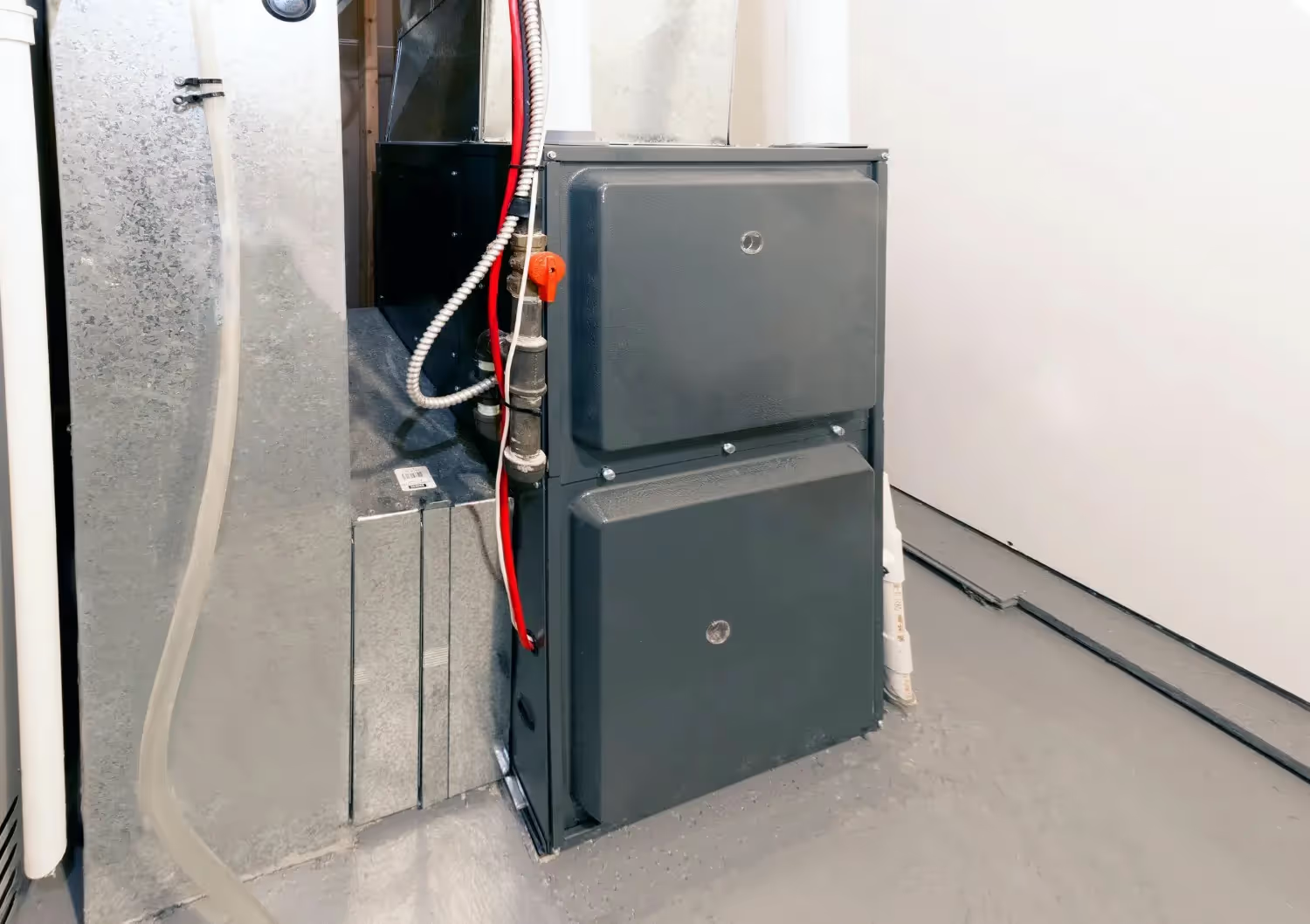
Our Step-by-Step Process to Keep You Warm
We utilize a systematic approach to heating installation that minimizes disruption to your daily routine while maximizing the performance of your new equipment. By adhering to a strict protocol, Martin's Heating & Air Conditioning ensures that every variable is accounted for, resulting in a system that operates at peak manufacturer specifications from day one.
Consultation and Sizing
The process begins with a technical consultation. We review the layout of your home and discuss your comfort preferences. If you have experienced hot or cold spots in certain rooms, we address these airflow issues during the design phase. We calculate the required heating capacity based on square footage, ceiling height, and orientation to the sun.
System Selection
Based on the load calculation, we present you with options that fit your efficiency goals and budget — view current promotions. We explain the difference between single-stage, two-stage, and variable-speed systems. We help you understand the AFUE (Annual Fuel Utilization Efficiency) ratings and HSPF (Heating Seasonal Performance Factor) ratings so you can project your future energy savings.
Installation Day Preparation
On the day of installation, our technicians arrive with a fully stocked truck containing all necessary transition pieces, sealants, and tools. We review the plan with you and shut down power and gas to the work area to ensure safety.
Mechanical Implementation
We proceed with the physical installation. This involves placing the indoor and outdoor units, brazing copper refrigerant lines (for heat pumps), and connecting flue pipes for gas furnaces. We pay special attention to the flue venting to ensure carbon monoxide is safely expelled from your home.
Sealing and Insulating
To prevent energy loss, we seal all connections between the new unit and the existing ductwork using mastic sealant and metal tape. We also insulate refrigerant lines and transition points to prevent condensation buildup, which is critical in our humid climate.
Commissioning and Testing
Once the physical work is done, we do not simply turn it on and leave. We perform a commissioning startup. This involves measuring static pressure within the ducts, checking temperature rise across the heat exchanger, and verifying proper gas pressure at the manifold. We test every safety switch and limit control to guarantee the system shuts down safely in the event of an issue.
Decision Guide: When to Opt for Installation Over Repair
Homeowners often struggle with the decision of whether to pour more money into an aging system or invest in a new installation. While repairs can solve immediate issues, there is a mathematical tipping point where replacement becomes the more financially prudent choice. Continuing to patch a failing system can lead to wasted energy dollars and the risk of a catastrophic failure during a cold snap.
You should consider moving forward with a new installation if:
The 50% Rule Applies
If the cost of the repair approaches 50% of the value of a new system, replacement is generally the better investment. A major repair, such as a cracked heat exchanger or a failed compressor, is often throwing good money after bad on a unit that has limited remaining life.
System Age Exceeds 15 Years
Most heating systems are designed to last between 12 and 15 years. Even if a 20-year-old system is running, it has likely lost significant efficiency. Modern units are vastly more efficient than those manufactured two decades ago, meaning a new installation could lower your monthly utility bills enough to offset the monthly cost of financing.
Rising Energy Bills
If your usage habits haven't changed but your heating bills are steadily climbing, your system’s internal components are wearing out. As motors and burners degrade, they must work harder to produce the same amount of heat.
Frequent Breakdowns
If you have required repairs more than twice in the last two years, the system is becoming unreliable. The cumulative cost of service calls, parts, and labor quickly adds up to the price of a down payment on a new unit.
Uneven Heating and Comfort Issues
If some rooms are freezing while others are stifling, or if the air feels clammy and humid, the current system may be improperly sized or the ductwork may be compromised. A new installation allows us to correct these fundamental design flaws.
Understanding Local Permitting and Seasonal Recommendations
Operating in the Lafourche Parish area requires specific knowledge of local environmental conditions and regulatory requirements. An installation that works in a dry, northern climate will fail here. Our region’s high humidity and specific weather patterns dictate how heating systems must be installed and protected.
Permitting and Compliance
Installation of HVAC equipment in Lockport requires adherence to local building codes. This includes obtaining the necessary mechanical permits before work begins. These codes regulate everything from the type of venting material used for gas furnaces to the electrical disconnect requirements for heat pumps. We manage the permitting process entirely, ensuring your installation passes inspection and maintains the validity of your home insurance.
Humidity Management
Our winters are mild but wet. A heating system must do more than just warm the air; it must also assist in managing indoor humidity. Oversized units satisfy the temperature setting too quickly and shut off before they can dehumidify the air, leading to mold growth and a clammy indoor environment. We select equipment that runs long enough to effectively condition the air, often recommending variable-speed blowers that offer superior humidity control.
Hurricane Preparedness
Because we are in a hurricane zone, the outdoor components of heat pumps or split systems must be secured properly. Local codes require specific strapping or mounting to concrete pads to ensure the unit remains stationary during high-wind events. We utilize corrosion-resistant hardware to withstand the salt air and moisture prevalent in the region.
Gas vs. Electric considerations
Depending on your specific location within the parish, you may have access to natural gas, or you may rely on electricity. We help you evaluate the cost-benefit analysis of gas furnaces versus electric heat pumps. In our climate, modern heat pumps are incredibly efficient and can handle the vast majority of heating days without utilizing expensive auxiliary heat strips.
Why Choose Us? Our Local Reputation and Credentials
Selecting the right contractor like Martin's Heating & Air Conditioning is the most critical variable in the longevity of your heating system. The highest-quality equipment will fail prematurely if installed incorrectly. We differentiate ourselves through a commitment to technical precision and a transparent, customer-focused process. We do not use high-pressure sales tactics; instead, we provide you with the data you need to make an informed decision for your home.
- Technical Certification: Our technicians undergo continuous training to stay updated on the latest HVAC technologies and code changes.
- Detailed Post-Install Walkthrough: We take the time to show you exactly how to operate your new system, how to change the filters, and how to program the thermostat for maximum savings.
- Respect for Property: We treat your home with care, ensuring that the workspace is cleaner when we leave than when we arrived.
A reliable heating system is essential for your comfort and safety. Do not wait until the first freeze to address a failing unit.
Ensure your home stays warm this season by scheduling your professional heating installation today.
Talk to a Local HVAC Expert

.avif)